

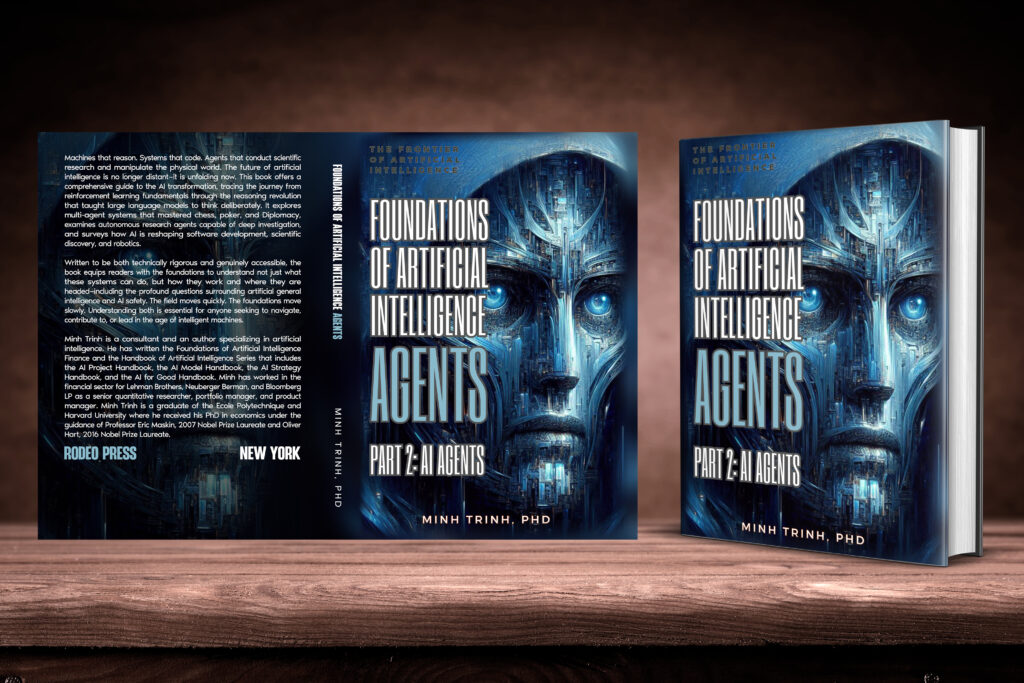


Artificial intelligence stands at an inflection point. The technologies that once seemed decades away—machines that reason, code, conduct scientific research, and manipulate the physical world—are arriving faster than even optimistic predictions suggested. This book maps the landscape of that transformation, from the mathematical foundations that make it possible to the frontier systems reshaping what machines can accomplish.
Beginning with reinforcement learning fundamentals and progressing through deep learning, multi-agent systems, and game theory, the book builds a comprehensive understanding of how modern AI systems learn and act. It examines the reasoning revolution that produced models capable of deliberate thought, explores autonomous research agents that can investigate complex questions across sources, and surveys the rapid transformation of software development through AI collaboration.
The book extends beyond digital systems to examine AI’s growing impact on scientific discovery—from AlphaFold’s breakthrough in protein structure prediction to emerging AI scientist architectures—and the new paradigm of vision-language-action models that enable robots to understand instructions, perceive their environment, and act in the physical world.
The final chapters confront the path toward artificial general intelligence: what it means, where current capabilities fall short, proposed architectural visions, and the safety concerns that accompany increasingly powerful systems.
Both rigorous and accessible, this book provides the technical depth necessary to understand these systems while remaining grounded in practical implications. The field moves quickly; the foundations move slowly. By understanding both, readers will be equipped not merely to observe the transformation underway but to participate in shaping it.
Table of Contents:
Chapter 1: Fundamentals of Reinforcement Learning
Chapter 2: Deep Reinforcement Learning
Chapter 3: Multi-RL Agents
Chapter 4: AI Reasoning Models
Chapter 5: Deep Research Agents
Chapter 6: AI Coding and Vibe Coding
Chapter 7: AI Scientists Transforming Scientific Discovery
Chapter 8: VLA Models and Robotics
Chapter 9: The Path of Artificial General Intelligence
Chapter 10. Conclusion: The Horizon Ahead
References